Radially expandable cannula systems and methods for use
Inventors
Atto, Zaid • Cicek, Seray • Dilbert, Chevis • Campbell, Catherine Mackenzie • Ladak, Aman
Interested in licensing this patent?
MTEC can help explore whether this patent might be available for licensing for your application.
Assignees
Member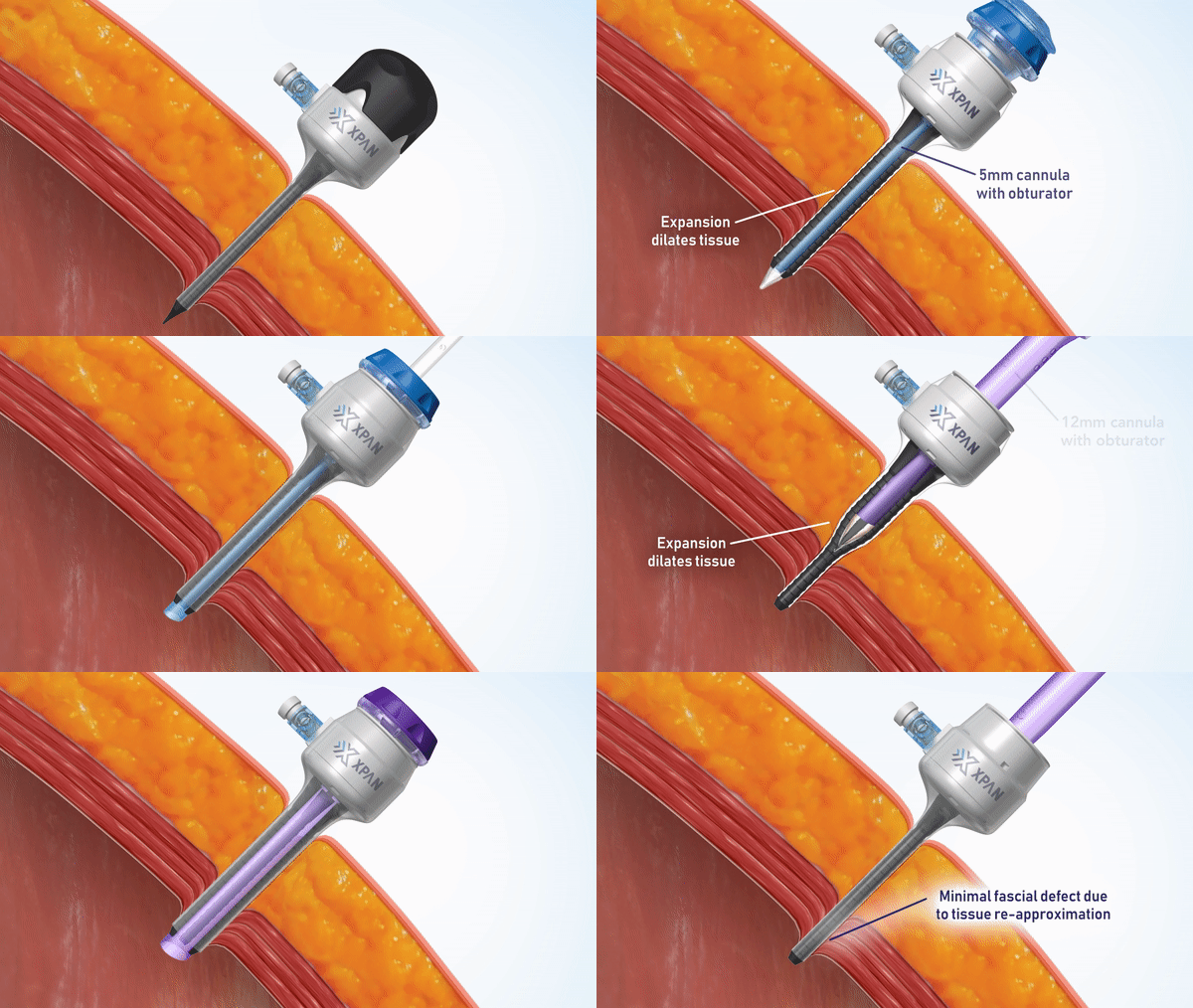 Xpan Inc.
Xpan Inc. develops minimally invasive surgical access technology, focusing on creating a universal trocar system utilizing patented radial dilation expansion. The company's mission is to increase patient safety, surgical efficiency, and overall healthcare cost-effectiveness through innovation. With FDA clearance and a growing intellectual property portfolio, Xpan's solutions address key shortcomings in traditional trocar access methods.
Xpan Inc. develops minimally invasive surgical access technology, focusing on creating a universal trocar system utilizing patented radial dilation expansion. The company's mission is to increase patient safety, surgical efficiency, and overall healthcare cost-effectiveness through innovation. With FDA clearance and a growing intellectual property portfolio, Xpan's solutions address key shortcomings in traditional trocar access methods.
Publication Number
US-12502203-B2

Publication Date
2025-12-23
Expiration Date
Abstract
A radially expandable trocar, port or cannula system is provided for use in minimally invasive surgeries. The cannula creates a port access with an initial small internal diameter. The passage of the cannula devices is defined by a plurality of elongate rigid members. A number of mechanisms are provided for expanding the passage of the cannula devices, by moving the plurality of elongate rigid members towards a larger radial location, thereby creating a larger internal diameter for the port. The elongate rigid members can be prevented from unintended movement when the system is at the un-expanded state, during expansion and when it is expanded to the desired larger diameter. Exemplary embodiments include methods of preventing gas loss from the tissue that would occur through the gaps created during expansion.
Core Innovation
The disclosure describes a cannula device for minimally invasive surgery that includes a first housing and a second housing aligned along a central axis, with a first throughbore and a second throughbore forming an inlet. A plurality of elongate rigid members extends distally from the first and second housings to cooperatively define a passage that is axially aligned with the central axis, with distal tips defining an outlet of the passage. An insertable member is insertable axially through the inlet and the first throughbore into the passage so that a distal end of the insertable member is positioned adjacent the outlet.
The insertable member is sized to cause axial movement of the first housing with respect to the second housing and to move the elongate rigid members radially outwardly away from each other to increase the size of the passage. The radially expanded passage is defined by the distal tips of the plurality of elongate rigid members, and the mechanical interconnection between the rigid members and the first housing is implemented by a track including inter-engaging parts that are slidable relative to one another. In particular configurations, the track inter-engagement includes first and second inter-engaging parts, with guides oriented diagonally relative to the central axis, and tongues and guides that cooperate to guide relative motion of the elongate rigid members during expansion.
In expanded-use configurations, an obturator is insertable axially through the inlet and the first throughbore into the passage such that a distal end of the obturator is positioned adjacent the outlet, with an obturator length selected so that the distal end of the obturator extends from the outlet when fully inserted. A tubular member carried around the obturator is introduced into the passage when the obturator is inserted, and the passage defines a first inner diameter in an initial unexpanded configuration that is expanded to a second diameter based on a larger second diameter of the obturator.
Claims Coverage
The partial content includes three independent claims: two cannula device claims and one method claim. Across the independent claims, the inventive coverage centers on the axially movable first housing relative to a second housing, the radially outward movement of elongate rigid members to increase passage size, and the track-based connection with slidable inter-engaging parts.
Axially driven radially expandable cannula passage with insertable member
A cannula device with a first housing defining a first throughbore and inlet, a second housing defining a second throughbore aligned along a central axis, a plurality of elongate rigid members extending distally that cooperatively define an axially aligned passage whose distal tips define an outlet, and an insertable member positioned adjacent the outlet and sized to cause axial movement of the first housing with respect to the second housing to move the plurality of elongate rigid members radially outward and increase the size of the passage.
Track-connected elongate rigid members with slidable inter-engaging parts
The plurality of elongate rigid members connected to the first housing by a track including inter-engaging parts that are slidable relative to one another.
Obturator-driven expansion with obturator length and tubular member
A cannula device that includes an obturator insertable through the inlet and the first throughbore into the passage to position a distal end adjacent the outlet and to cause axial movement of the first housing relative to the second housing and radial outward movement of the plurality of elongate rigid members to increase the size of the passage, where the obturator has a length such that the distal end extends from the outlet when fully inserted, and where a tubular member carried around the obturator is introduced into the passage during obturator insertion to expand an initial unexpanded first inner diameter to a second diameter.
Medical procedure method using inserted distal tips and instrument introduction through the passage
A method for performing a medical procedure within a subject’s body by providing a cannula device with aligned housings and a passage defined by elongate rigid members connected to the first housing by a track with slidable inter-engaging parts, inserting the distal tips of the elongate rigid members through tissue, inserting an insertable member through the inlet and first throughbore into the passage with a distal end positioned adjacent the outlet such that the insertable member causes axial movement of the first housing relative to the second housing to move the elongate rigid members radially outward and increase the passage size, and introducing one or more instruments through the passage to perform the medical procedure.
Across the independent claims, the inventive coverage is directed to an expandable cannula where axial movement of one housing relative to another, driven by an insertable member or an obturator, causes rigid members connected via slidable track inter-engaging parts to move radially outward to increase passage size, enabling introduction of instruments through the expanded passage for a medical procedure.
Stated Advantages
Not explicitly described in patent.
Documented Applications
Performing a medical procedure within a subject's body using the cannula device and introducing one or more instruments through the passage to perform the medical procedure.
Interested in licensing this patent?