Radially expandable cannula devices, and systems and methods for using them
Inventors
Interested in licensing this patent?
MTEC can help explore whether this patent might be available for licensing for your application.
Assignees
Member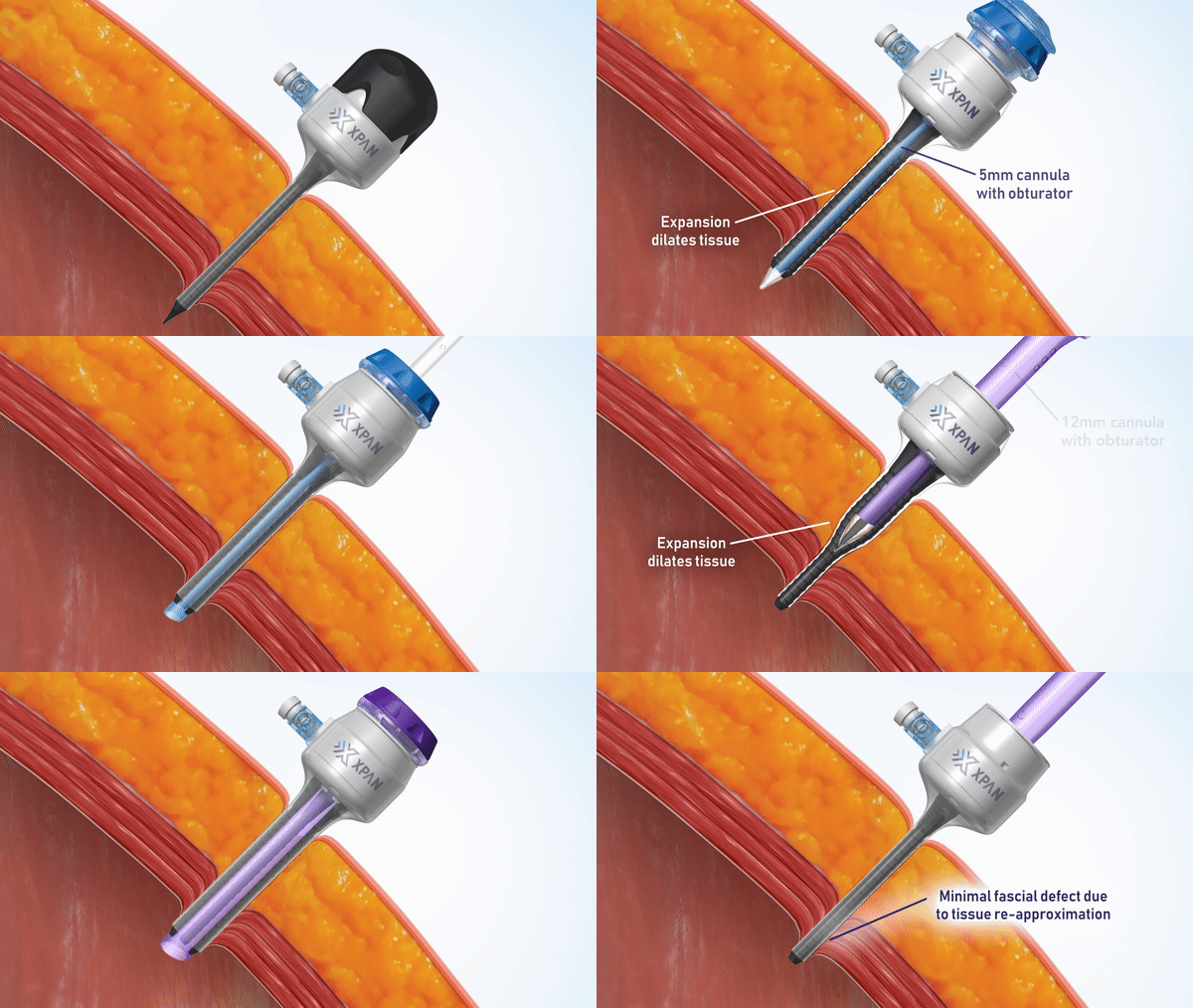 Xpan Inc.
 develops minimally invasive surgical access technology, focusing on creating a universal trocar system utilizing patented radial dilation expansion. The company's mission is to increase patient safety, surgical efficiency, and overall healthcare cost-effectiveness through innovation. With FDA clearance and a growing intellectual property portfolio, Xpan's solutions address key shortcomings in traditional trocar access methods.
Xpan Inc. develops minimally invasive surgical access technology, focusing on creating a universal trocar system utilizing patented radial dilation expansion. The company's mission is to increase patient safety, surgical efficiency, and overall healthcare cost-effectiveness through innovation. With FDA clearance and a growing intellectual property portfolio, Xpan's solutions address key shortcomings in traditional trocar access methods.
Publication Number
US-12484931-B2

Publication Date
2025-12-02
Expiration Date
Abstract
Cannula devices, systems, and methods are provided for introducing one or more instruments into a patient's body to perform a procedure. In one example, the cannula device includes first and second housings defining a throughbore, and a plurality of elongate members extending distally from the housings, the elongate members cooperatively defining a passage axially aligned with the throughbore between proximal ends and distal tips of the elongate members. The first housing is moveable in an axial direction with respect to the second housing to cause the proximal ends of the elongate members to move outwardly to increase a size of the passage and, optionally, may taper when expanded. Optionally, one or more secondary devices, e.g., an obturator with a sharpened tip, or an obturator and tubular access device may be provided that may be inserted through the throughbore into the passage before expansion of the passage.
Core Innovation
The patent addresses problems associated with fixed-diameter laparoscopic ports/trocars, including high insertion force, risks associated with upsizing, loss of pneumoperitoneum, and tissue trauma. It motivates expandable cannula devices for minimally invasive surgery and neurosurgery by changing how an axially aligned passage is formed during insertion.
An expandable cannula device is described with a first housing and a second housing defining throughbores aligned along a central axis, where the first housing is movable in an axial direction with respect to the second housing. A plurality of elongate rigid members cooperatively defines a passage axially aligned with the first throughbore, and axial movement causes the proximal ends of the elongate members to move outwardly away from each other to increase a size of the passage.
The disclosure further describes an internal conical taper/guide to enable lower-force and more controllable insertion. Expansion and gas containment are addressed using a membrane overlying the elongate members from the proximal ends at least partially toward the distal tips to provide a fluid-tight seal to prevent gas within the passage from escaping between the elongate members.
Multiple embodiments are summarized, including obturator-driven and obturator-less configurations, a resistive member as an optional backup valve, hinge/linkage-based expansion and retraction, and robotic mounting/actuation. A comprehensive gas-tight valve system is also described, including one-way valves and optional backup valves and an inlet arrangement associated with a stopcock side port, along with features for seamless distal interfaces and sealing structures for sealing interactions.
Claims Coverage
The independent claims include four independent claim sets: clm-00001, clm-00014, clm-00016, and clm-00018. They cover five inventive features centered on expansion, sealing, tissue engagement, obturator coupling, and gas delivery.
Expandable cannula passage driven by relative axial housing movement
A cannula device comprising first and second housings defining aligned throughbores along a central axis, where the first housing is moveable in an axial direction along the central axis with respect to the second housing; a plurality of elongate members cooperatively defining a passage axially aligned with the first throughbore; and axial movement of the first housing causing proximal ends of the elongate members to move outwardly with respect to the central axis to increase a size of the passage.
Fluid-tight membrane sealing over expandable elongate members
A membrane overlying the elongate members from the proximal ends at least partially towards the distal tips to provide a fluid-tight seal to prevent gas within the passage from escaping between the elongate members, wherein the membrane substantially encases the first and second housings other than an inlet region.
Tissue engagement features to prevent migration
Each elongate member comprises a plurality of engagement features on an outer surface thereof for engaging surrounding tissue to prevent migration of the cannula device.
Resistive member coupled to obturator axial movement
A first obturator configured to be inserted into the first throughbore through the unexpanded passage such that a tip of the first obturator is exposed prior to inserting the cannula device into tissue; wherein the first housing comprises a resistive member disposed across the first throughbore, and wherein the first obturator is configured to engage the resistive member to couple axial movement of the first housing to corresponding movement of the first obturator.
System with side-port gas delivery into a lumen through sidewall openings
A system for introducing one or more instruments into a patient's body comprising a cannula device with a first and second housings defining a throughbore along a central axis, where one of the first and second housings comprises a side port communicating with the throughbore such that a source of pressurized gas connected to the side port can deliver gas through one or more openings into the throughbore; and an elongate tubular member sized for insertion through the throughbore into the passage, the tubular member comprising one or more openings in a sidewall thereof communicating with the lumen such that pressurized gas introduced from the side port passes through the one or more openings into the lumen.
Across the independent claims, the core coverage centers on an expandable cannula device where relative axial movement between housings drives outward movement of proximal ends of multiple elongate members to increase an axially aligned passage size, while a membrane provides a fluid-tight seal to prevent gas escape. Additional independent coverage specifies tissue-engaging engagement features to prevent migration and an obturator/resistive-member coupling arrangement. The system independent claim further adds a side-port pressurized gas delivery arrangement using an elongate tubular member with sidewall openings communicating with a lumen.
Stated Advantages
Not explicitly described in patent.
Documented Applications
Not explicitly described in patent.
Interested in licensing this patent?