Radially expandable cannula devices, and systems and methods for using them
Inventors
Interested in licensing this patent?
MTEC can help explore whether this patent might be available for licensing for your application.
Assignees
Member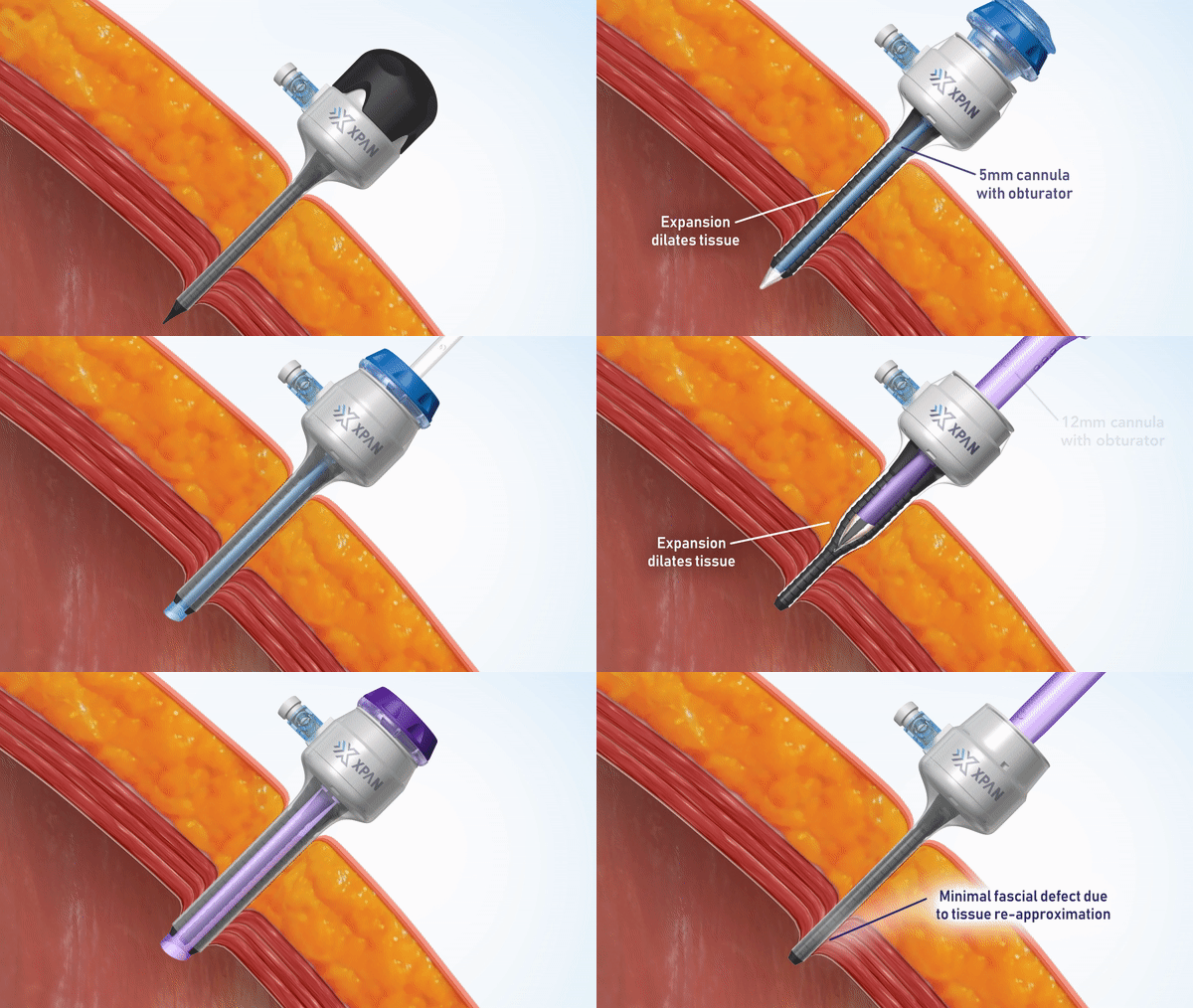 Xpan Inc.
Xpan Inc. develops minimally invasive surgical access technology, focusing on creating a universal trocar system utilizing patented radial dilation expansion. The company's mission is to increase patient safety, surgical efficiency, and overall healthcare cost-effectiveness through innovation. With FDA clearance and a growing intellectual property portfolio, Xpan's solutions address key shortcomings in traditional trocar access methods.
Xpan Inc. develops minimally invasive surgical access technology, focusing on creating a universal trocar system utilizing patented radial dilation expansion. The company's mission is to increase patient safety, surgical efficiency, and overall healthcare cost-effectiveness through innovation. With FDA clearance and a growing intellectual property portfolio, Xpan's solutions address key shortcomings in traditional trocar access methods.
Publication Number
US-11337727-B2

Publication Date
2022-05-24
Expiration Date
Abstract
Cannula devices, systems, and methods are provided for introducing one or more instruments into a patient's body to perform a procedure. In one example, the cannula device includes first and second housings defining a throughbore, and a plurality of elongate members extending distally from the housings, the elongate members cooperatively defining a passage axially aligned with the throughbore between proximal ends and distal tips of the elongate members. The first housing is moveable in an axial direction with respect to the second housing to cause the proximal ends of the elongate members to move outwardly to increase a size of the passage and, optionally, may taper when expanded. Optionally, one or more secondary devices, e.g., an obturator with a sharpened tip, or an obturator and tubular access device may be provided that may be inserted through the throughbore into the passage before expansion of the passage.
Core Innovation
A cannula device includes a first housing and a second housing defining first and second throughbores aligned along a central axis. The second housing is moveable in an axial direction along the central axis with respect to the first housing, and a plurality of elongate members cooperatively define a passage axially aligned with the first throughbore between proximal ends and distal tips of the elongate members.
Guide elements are provided on the proximal ends of the elongate members and on the first and second housings. The guide elements cooperate such that axial movement of the first housing with respect to the second housing along the central axis causes the proximal ends of the elongate members to move outwardly with respect to the central axis and away from each other, thereby increasing a size of the passage.
When the distal tips are constrained, the elongate members are configured to define a tapered shape extending from the proximal ends towards the distal tips. The system further includes introducing one or more instruments into a patient's body to perform a procedure by using the cannula device and a secondary device or obturator inserted through the throughbore into the passage.
The distal tapers of the elongate members provide an outlet having a larger diameter than the passage, and the secondary device or obturator engages the first housing to cause distal relative motion of the housings that moves the elongate members away from each other to increase the passage size. Embodiments also include obturator tips sized to receive a portion of the obturator tip and, optionally, sealing and valve arrangements to control gas loss.
Claims Coverage
The document provides three independent claims that share a common expandable cannula mechanism with multiple elongate members driven by axial relative motion of two coaxial housings through cooperating guide elements. Across the independent claims, additional inventive feature sets are expressed for tapered outlet behavior and for coupling expansion to an obturator or secondary device, optionally including sealing and valve related features.
Axially guided expansion of elongate members to increase passage size with taper
A first and a second housing define a throughbore aligned along a central axis, where the second housing is moveable in an axial direction with respect to the first housing; a plurality of elongate members cooperatively define a passage axially aligned with the first throughbore between proximal ends and distal tips; guide elements on the proximal ends and on the first and second housings cooperate so axial movement of the first housing with respect to the second housing causes the proximal ends of the elongate members to move outwardly with respect to the central axis and increase a size of the passage; the elongate members define a tapered shape extending from the proximal ends towards the distal tips when distal tips are constrained.
System with obturator whose tip is received by distal tapers for larger outlet diameter
A system including a cannula device with first and second housings, axial relative motion between housings, elongate members defining a passage aligned along a central axis, and guide elements configured to move proximal ends outwardly away from each other to increase a size of the passage; distal tips include interior tapers from the passage to an outlet of the elongate members such that the outlet has a larger diameter than the passage; an obturator having an elongate shaft configured to be inserted through the throughbore into the passage and an obturator tip with a cross-section larger than the outer diameter, where the tapers of the distal tips are sized to receive a portion of the obturator tip when the shaft is positioned within the passage.
System using secondary device inserted through the throughbore to drive housing movement and passage expansion
A system including a cannula device with first and second housings defining a throughbore along a central axis, where the first housing is moveable in an axial direction with respect to the second housing; elongate members extending distally from the first and second housings cooperatively defining a passage axially aligned with the throughbore between proximal ends and distal tips; guide elements configured to cooperate so axial movement of the first housing with respect to the second housing causes the proximal ends of the elongate members to move outwardly away from each other and increase a size of the passage; and a secondary device sized for insertion through the throughbore into the passage, where the secondary device engages the first housing to cause the first housing to move distally relative to the second housing to move the elongate members away from each other and increase the size of the passage.
Across the independent claims, the shared inventive core is the axial, guide-element-driven outward movement of proximal ends of elongate members to increase an axially aligned passage size, including formation of a tapered shape when distal tips are constrained. The independent system claims additionally specify how obturator or secondary devices inserted through the throughbore engage the cannula or are received by distal tapers to produce an outlet larger than the passage and to drive expansion by relative distal motion of the housings.
Stated Advantages
Increases a size of the passage by moving proximal ends of elongate members outwardly away from each other.
Provides a tapered shape extending from proximal ends towards distal tips when distal tips are constrained.
Creates an outlet having a larger diameter than the passage via interior tapers at distal tips.
Documented Applications
Introducing one or more instruments into a patient's body to perform a procedure.
Interested in licensing this patent?